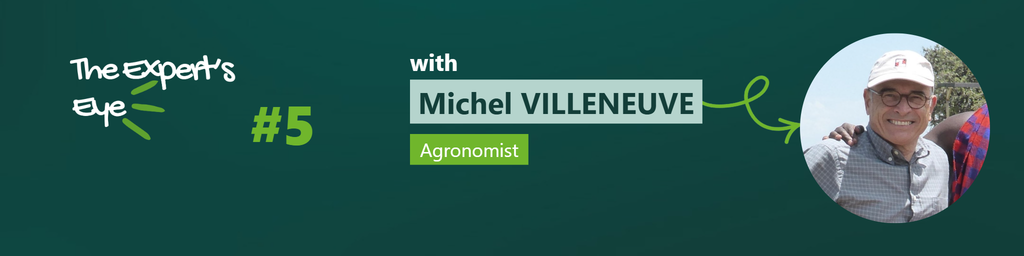
We are kicking off season 2 of our Expert’s Eye series with Michel Villeneuve, an agronomist specialising in tropical agriculture and a Senior Advisor for Apexagri by Cubik !
Michel, could you briefly tell us about your background?
I am an agronomist by training, with a specialisation in tropical agriculture.
I spent 34 years working in plant pathology, the study of plant diseases and how to protect crops against them. I held a wide range of positions over that time. I started out in research and development, moved into field development, and finished in sales as Africa Manager for a multinational company. Altogether, I spent 25 years in Africa. Those years gave me first-hand knowledge of the crops, the growers and the realities on the ground in a great many countries.
Since 2013, I have worked as an independent consultant through my own firm, BIOGECROP. I focus on Africa and the Middle East, in crop protection and plant nutrition.
What expertise do you bring to Apexagri?
Through BIOGECROP, I provide technical expertise on establishing crops in Africa. I am involved at every key stage: selecting species and varieties suited to the local context, designing the crop protection strategy and managing plant nutrition. In an agricultural project, this is often where success or failure is decided. The wrong variety or the wrong crop management programme can jeopardise an entire investment.
I also give Apexagri access to an extensive network of specialist partners in African agriculture. After so many years on the continent, I know a great many people on the ground: technicians, distributors, operators, growers… This network allows us to move quickly and to rely on trusted contacts in every country.
How would you describe Apexagri in three words?
- Agility: the team adapts quickly to very different contexts, countries and client needs.
- Technical and financial expertise: Apexagri combines agronomic expertise with economic and financial analysis. That combination is essential for an agricultural project to stand up.
- Delivery: assignments are carried out rigorously, and the aim is always to deliver tangible results for the client.
What do you enjoy about working with Apexagri?
First, the youth of the team. It is stimulating to work with people who are dynamic, curious and motivated. Second, our skills complement each other. I bring my field experience and my technical knowledge of African crops. The Apexagri team brings other perspectives, particularly on strategy and financial modelling. It is a partnership that works very well and allows us to address projects as a whole.
Is there a particular assignment that stands out for you?
The first that comes to mind is the assignment in Ethiopia, carried out with Josep. It was a very motivating project, in a country with significant agricultural potential, where we had to make a concrete assessment of the scope for developing a new production. I am currently working on an assignment in northern Côte d’Ivoire, which is also very exciting. These are projects where you can feel that our work can have a real impact on the agricultural development of a region.
In your view, what are the main challenges for more sustainable agriculture?
I see three major challenges:
- Getting stakeholders on board: this is the number one challenge, especially in Africa, where value-creation goals in agriculture tend to be short-term. All too often, the priority is a quick return on investment.
- Protecting natural capital: the pursuit of a quick return on investment sometimes comes at the expense of soil fertility, crop health or the long-term viability of the farm.
- Scaling up what works: some major agribusinesses (banana, pineapple, cereal and horticulture producers…) take a long-term view. They show that sustainable and profitable agriculture is possible. The challenge now is to scale this approach up across the wider sector.
Is there a project or success story in agriculture that deserves to be better known?
I am thinking of several private investors who built farms from scratch in the middle of nowhere, in Tanzania, Malawi, Zambia, Senegal, Kenya… They started from zero, often in remote areas, and built high-performing farming operations. What they have in common is that, every time, these were very well-managed private investments. These successes show that with a clear vision, strong technical know-how and rigorous management, you can achieve great things in African agriculture.
What advice would you give a company looking to structure a value chain or develop an agricultural project?
- Surround yourself with the right experts: an agricultural project draws on a wide range of skills, from agronomy, crop protection and plant nutrition to economics and logistics. You need to rely on people who know the realities on the ground.
- Set achievable and profitable objectives: for the short, medium and long term, with a clearly identified market, whether for export or for the domestic market.
- Never neglect people management: this is fundamental. Without leadership and very rigorous organisation, no project can succeed, however sound it is technically.
Any final thoughts?
Africa has immense agricultural potential, provided you approach it with commitment, patience and the right expertise. I am delighted to be contributing, alongside Apexagri, to projects that are moving in that direction.
Many thanks to Michel Villeneuve for opening the second season of The Expert’s Eye by answering our questions! Read the previous issues with Michel Montet, Edouard Huchin, Paul Fert and Mohamed Ayoub Sabir.