Interview with Mohamed Ayoub Sabir, agricultural engineer & Apexagri expert
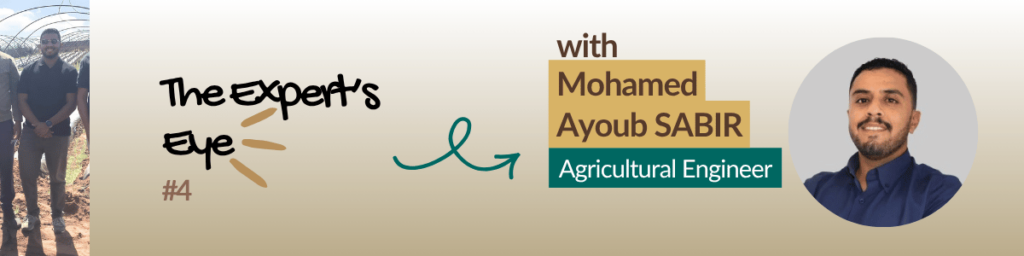
Hello Ayoub, can you tell us a little bit about your background?
I am an agricultural engineer and a graduate of the Hassan II Institute of Agronomy and Veterinary Medicine in Rabat. I have eight years’ experience in agricultural development and the management of agricultural projects.
My first professional role was at Maïsadour Maroc, where I worked on numerous aspects of agricultural development, specialising in the production of fruit and vegetables for export to the European market. I was primarily involved in operational and technical aspects: production, technical and economic studies, research and development, as well as support for and restructuring of supply chains.
And, of course, I collaborate with Apexagri on agricultural projects at both national and international levels.
What expertise do you bring to Apexagri?
I bring a solid background in agronomy, combined with an economic and strategic approach. In practical terms, I carry out assessments, evaluate the technical and financial feasibility of projects, and propose realistic action plans.
As an agronomist, I know how to combine theoretical and practical aspects, whilst taking into account the business dimension and profitability. In the world of agribusiness, if you cannot reconcile these elements, it is impossible to build a sustainable project.
I often act as the technical lead within teams. What I particularly appreciate is the complementary nature of the teams at Apexagri, which operate in pairs: on the one hand, technical agronomic expertise, and on the other, the business, consultancy and value chain approach. This synergy enables us to develop and deliver relevant and effective outcomes.
In three words, how would you describe Apexagri?
Visionary: Apexagri has a genuine ability to anticipate developments in the agricultural sector, particularly through active market monitoring (follow them on social media!). Keeping abreast of international trends is a major strength.
Rigourous: The methodology applied during projects and the quality of the analyses are reflected in the deliverables. This rigour is evident at every stage of the projects.
Committed: The sustainable development of supply chains lies at the heart of Apexagri’s philosophy. This commitment is greatly appreciated by clients, especially in the current climate.
What do you like most about working with our team?
What I love is the diversity of the projects. I’ve been involved in three assignments, each with a different context and set of requirements. This diversity leads to very fruitful discussions with everyone involved: producers, operators and other stakeholders. Every assignment is an opportunity to push myself and learn, whilst making a tangible impact on the ground!
Apexagri’s philosophy – which is scientific, pragmatic and results-oriented – suits me perfectly. Working with a multidisciplinary team doesn’t necessarily make things go faster, but it does make them far more efficient. By combining technical expertise with a business focus, we stay focused on what matters most and maximise efficiency.
Finally, the team spirit within the team is exceptional. Even with little time to settle in, roles and objectives are clear, and collaboration happens organically. This makes every assignment more rewarding and interesting.
Is there one mission that stands out in your mind?
The three missions I took part in were very different, but if I had to choose one, it would be the one in Saudi Arabia (for AFALULA). The human factor was key: excellent team spirit, plenty of discussion, and a mix of skills that made the work run smoothly and kept us motivated.
The scale of the project was impressive: assessing the potential for developing high value-added crops in a very challenging agro-climatic context. Together, we were able to gain a better understanding of the local constraints and work more effectively.
A memorable anecdote: Michel (the other agronomist on the project) didn’t receive his suitcase on the first day. After a complicated ordeal (a delayed flight, his suitcase held up in Paris…), an agent went to the trouble of tracking the suitcase’s journey, collecting it himself and alerting Michel, who had to drive for two hours to retrieve it. Because of this mishap, Michel spent the first two days in some makeshift clothes we’d bought locally… An adventure that gave us a good laugh, even if it wasn’t much fun for him!
What do you think are the major challenges to a more sustainable agriculture?
I see three major challenges:
- Adapting to climate change: The changes are becoming increasingly pronounced and difficult to ignore. They are forcing us to rethink our production systems and methods.
- Economic viability: During my last four years at Maïsadour as head of the agriculture and development department, I saw just how crucial viability is for all stakeholders in the supply chain. Without profitability, there can be no sustainability.
- Responsible management of natural resources: This point is linked to the first, but it deserves to be emphasised. Sustainability depends on the sensible use of resources, which lies at the heart of today’s agricultural models.
Do you know of a project or a success story in the agricultural sector that deserves to be shared?
I draw on my experience at Maïsadour to discuss agricultural aggregation. This model involves an aggregator working with a network of producers (the ‘aggregated farmers’). The aggregator manages the value chain and liaises with customers, whilst the producers focus on production.
At Maïsadour Morocco, this model is used in particular for sweetcorn, but other operators use it for beans or soft fruits. The aggregator provides close technical support, from planting through to harvest, using scientific methods. It also contributes to production costs (50–60 per cent), which eases the pressure on producers.
This system benefits the entire ecosystem: it improves production, enhances the value of products on national and international markets, and provides a form of ongoing training for producers. It is a model I would like to see rolled out across other sectors.
What advice would you give to a company that wants to structure a supply chain or develop an agricultural project?
- Gaining a clear understanding of the context: Whether it is a project started from scratch or a restructuring exercise, it is essential to identify the available resources, local expertise and lessons learnt from past experiences.
- Building on a shared-value approach: The producer must be at the heart of the project, not only in its design but also in the decision-making process.
- Surrounding yourself with multidisciplinary expertise: Technical, economic, organisational… This prevents the approach from becoming overly theoretical. Many projects fail because they are unrealistic. Apexagri excels in bringing together these different areas of expertise.
- Calling on experts (such as Apexagri!): To avoid pitfalls and ensure the project is both ambitious and realistic.
Any final word?
Working with Apexagri means combining expertise, pragmatism and impact. It is an approach that makes a difference on the ground.
A big thanks to Mohamed Ayoub Sabir for answering our questions in this knew format “The Expert’s Eye”! Discover our previous editions with Michel Montet, Edouard Huchin et Paul Fert !