Interview with Paul Fert, Beekeeper and Expert for Apexagri
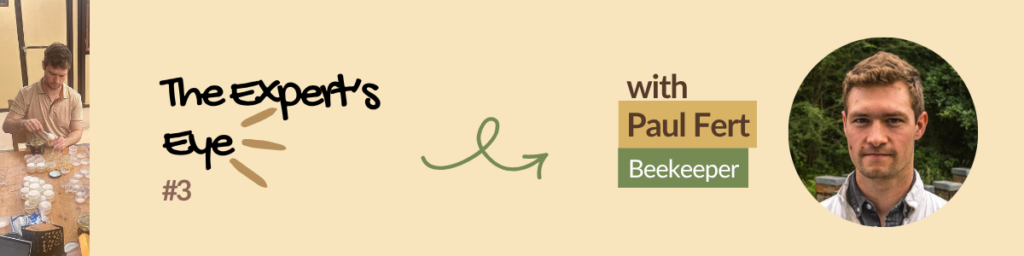
Hello Paul, can you tell us a little about your background?
My name is Paul Fert. I have been a beekeeper for almost 10 years and am the son and grandson of beekeepers in the Pyrénées-Atlantiques. At the start of my career, I was more focused on communications. After studying at Sciences Po Bordeaux, I worked on a European pilot project between Marseille and Brussels. My role involved meeting with the media and politicians to secure funding for research into bee health, train beekeepers across Europe and raise awareness about bee conservation.
So, at the time, I started working in the beekeeping sector, though it wasn’t an initial passion of mine. Then an opportunity arose: to take over my father’s business, as he was about to retire.
Today, our beekeeping operation is situated on the hillsides of Béarn. We move our hives to the Pyrenees to produce a variety of honeys, and we are not far from the Landes forest. We produce around 4 tonnes of honey a year, with 300 to 350 hives depending on the season. It is a family-run beekeeping farm of a standard size. We also breed and select queen bees, and we have switched to organic farming.
What expertise do you bring to Apexagri?
At Apexagri, I primarily contribute my expertise in beekeeping, with a particular focus on queen rearing and selection. My experience is based on 40 years of family tradition, as well as an international perspective that many beekeepers lack. I attend seminars all over the world, such as ApiMondia every two years, and have built up an international network. I am used to delivering training courses and writing reports and articles.
I began working with Apexagri in late 2021 on a project to explore beekeeping in the AlUla region of Saudi Arabia, where I met as many stakeholders as possible – beekeepers, honey sellers – to understand what could be improved. I then produced a report with recommendations on how to develop beekeeping in this region!
In three words, how would you describe Apexagri?
First, I would highlight the international aspect: Apexagri has an extensive network that brings together a wealth of highly valuable expertise.
Then, I would mention the expertise: the people who work there are skilled and passionate. Whether it is for consultancy projects, training, logistics or event organisation, support is always on hand. As an external service provider, I feel well supported and know I can count on the necessary resources!
Finally, I would of course mention reliability and professionalism. Our working relationship, which began in 2021 and continues today in complete trust, is a testament to this.
What do you like most about working with our team?
The assignments on offer are meaningful. In the projects we carry out together, we support beekeepers, but more broadly speaking, it is about helping producers on the other side of the world, supporting them, and helping them to develop their skills and receive training. It is very rewarding. The support provided is of a high standard, and the working relationships with the various people we deal with are excellent.
Is there one mission that stands out in your mind?
The mission that made the biggest impression on me was the apiculture project in AlUla. It was an unforgettable experience, which took place in two phases. First, in 2021, there was an exploratory phase during which we did not know how many beekeepers there were, how they worked, or what the beekeeping sector meant for the local area. We produced the first report on beekeeping in the region.
Then, from 2024 onwards, there was a support and training phase, involving the characterisation of the different honeys from AlUla. The flora and climate there are very different from what is found elsewhere in the world. It was fascinating to work on how best to produce honey, creating descriptive sheets for each variety: citrus honey, moringa honey, desert acacia honey… We sent samples for analysis to study the differences in composition, sugars and enzymes.
I spent over forty days there, which was a real stroke of luck. It was the longest assignment I have ever undertaken. Unfortunately, I could not take part in the first honey festival held there, as it was right in the middle of the beekeeping season, starting in mid-March 2025. For a beekeeper, it is difficult to be away for more than a week at that time of year. But I was able to attend the second edition last October, which was a real success!
What do you think are the major challenges for sustainable agriculture?
It is hard to be concise when the challenges are so great! For me, sustainable agriculture must respect nature as much as possible and work with it, minimising negative impacts and striving to have a positive impact. It is also essential that farmers are able to earn enough to make a living from their work. Agriculture can only survive if it is economically viable!
In my view, we therefore need to move forward on three pillars: respecting biodiversity and the climate, ensuring a sufficient income for farmers, and producing quality food at a reasonable price. These three elements are inseparable.
Do you know of a project or a success story in the agricultural sector that deserves to be shared?
One example that springs to mind is the “Ceinture Verte” (green blet) project in France. The idea is to acquire land on the outskirts of medium-sized or large towns, rather than allowing it to be built on. These plots are taken over by market gardeners who receive almost turnkey support. They start producing immediately, with technical support and guaranteed outlets thanks to local markets and the catering sector.
Some market gardeners become profitable from the very first year, with products certified as organic and locally sourced. This project was trialled in Pau and has since been rolled out to other towns and cities across France.
What advice would you give to a company that wants to structure a supply chain or develop an agricultural project?
First, you need to have a thorough understanding of the sector in question. As we did in AlUla, it is essential to meet with all stakeholders, from the smallest to the largest, to understand the challenges and complexity of the sector.
Next, you need to ensure a fair distribution of value: you must not favour only those further up or down the supply chain, nor the largest players. Everyone must benefit.
Finally, it is crucial to guarantee sustainable markets. Setting up farmers is one thing, but you must ensure there are viable markets in the long term. It makes more sense for products to be distributed locally, with strong roots in their local area. If the local population is not sufficient to absorb production, wider markets, or even exports, must be considered.
In beekeeping, it is difficult to establish a structured approach. Research must be coordinated, training developed, and it must be ensured that scientific discoveries and training programmes are linked. We must also raise awareness of bee products so that local demand can absorb this production and ensure a reasonable income for beekeepers…
To conclude, there is no harm in expanding the knowledge of those involved in the sector!
A big thank you to Paul Fert for agreeing to take part in this new “Expert’s Eye” by answering our questions! You can also find the two previous editions with Michel Montet and Edouard Huchin !