Interview with Michel Montet, Agroeconomist and Expert for Apexagri
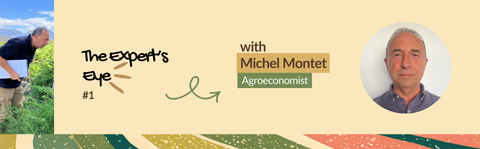
Hello Michel, can you tell us a little about your background?
My name is Michel Montet, I am 68 years old and I am an agricultural engineer by training. I started my career in a design office in southwestern France, where I worked on soil studies, drainage, and irrigation. I then joined Cargill—which has since been acquired by Monsanto—in the seed sector, first as a sales representative and then as a manager.
Later, I held various management positions in cooperatives, notably at Maïsadour for nearly twenty years, where I dealt with plant production chains, but also animal feed and market management. Maïsadour already had very extensive production chains, which allowed me to forge many links and develop varied and in-depth knowledge.
My daily work within the cooperatives was marked by several challenges, such as the issue of GMOs, regulations on certain molecules, and above all environmental issues. Environmental issues became increasingly important, and I proposed initiating and formalizing Maïsadour’s sustainable development policy long before this position was assigned to a specific team.
After retiring in 2019, I continued to work with Apexagri, carrying out international assignments, notably in Madagascar, South Africa, and Brazil.
What expertise do you bring to Apexagri?
What I find most satisfying about the projects I work on with Apexagri is that almost everything I have learned during my career has been put to good use! My first job, in a design office, gave me knowledge of soils, agricultural hydraulics, and the environment, which are now at the heart of my work. I then gained solid experience in supply chain management: economics, trade-offs, remuneration, quality, quantity, etc. Finally, I know how to set up and manage a network of producers. This is not something that can be improvised! I have found that farmers, wherever they are, share similar fundamentals. It is therefore necessary to be able to identify them, beyond different languages and customs.
What really fascinates me is everything related to botany and the environment. I also enjoy addressing economic and scientific aspects. Working with Apexagri allows me to touch on all of these areas, which is very stimulating!
In three words, how would you describe Apexagri?
I would say it is a flexible, responsive, and adaptable organization. At Apexagri, we have the ability to see the big picture, in 3D, while also going into detail. One of our strengths is combining purely agricultural skills with a consulting approach. This allows us to provide inventive and original solutions.
What is unique about Apexagri is that we don’t treat all problems the same way. We do not follow a ready-made recipe: we tailor our solutions to each individual case.
What do you like most about working with our team?
The variety of topics is incredible: no missions are alike. We work on niche industries, such as silkworms in Brazil, or a variety of food projects in Africa and the Middle East.
Secondly, the way experts and consultants work together is unique. It can be confusing at first, but this model pushes us out of our comfort zone. In my partnership with the consultant, I have to highlight the key points specific to agriculture, while the consultant structures the project. It’s a very intellectually stimulating approach!
Another aspect that interests me is the clients. We work with industries that are using more and more agricultural raw materials. These companies are often at a loss when it comes to agricultural issues, as they are used to working with very long supply chains and numerous intermediaries. We can provide them with real expertise.
I also find it very motivating to work with large French companies that are under pressure from environmental and animal welfare issues. We have the opportunity to contribute to concrete solutions! These environments are often very far removed from agriculture: they live in a very corporate world of PowerPoint presentations, KPIs, and business reviews. When I explain to a director that in agriculture, you only see results two years later, it always surprises them. But in the end, we manage to help them better control their upstream processes!
Is there one mission that stands out in your mind?
The mission in South Africa (which is still ongoing) is the one that has made the biggest impression on me. It combines the prestige of the client, a major player in the luxury sector, with the prestige of the country itself.
It had everything: we started with an assessment of the ostrich industry. By talking to the various players in the field, we discovered the realities behind the rhetoric, which led us to adapt the project. This resulted in an ecological restoration operation along a river to remove invasive plants that were consuming insane amounts of water.
Today, we are working on the active restoration of this environment by uprooting Acacia mearnsii (an invasive plant distantly related to mimosa) and replanting native species to rebuild an ecosystem closer to what it should be, and which consumes much less water. Restoring this ecosystem frees up water and promotes agricultural development in the region.
What do you think are the major challenges for sustainable agriculture?
The main problem is the lack of competencies. The agricultural sector does not employ enough agronomists! Yet sustainable agriculture is complex and requires considerable technical and scientific input. There is technology, data… But we also need to be able to synthesize climate, resource management, and agricultural practices that need to evolve.
Farmers are reluctant to abandon a practice that works for something new, especially if they perceive the change as a risk. This means that a lot of expertise are required to support them, which is often underestimated. Some people think that making big claims is enough, but it’s not that simple! In agriculture, there are many factors that are beyond our control. Some years are not representative, so it can be difficult to know which levers to pull.
What advice would you give to a company that wants to structure a supply chain or develop an agricultural project?
First, you always need to have product-related KPIs. I am struck by the number of projects that claim to be sustainable—talking about water, pesticides, or child labor—but forget about the product. If you’re in agriculture, it’s primarily to produce!
Let me give you a very simple example: if we say, “We have saved X thousand cubic meters of water,” we need to ask ourselves how this translates into products. Because the best way to save water is not to water at all… but if yields fall by 75%, that’s a problem! A KPI on its own, without any link to the product, is useless. Yet most companies do not link their KPIs to production in tons. However, this is the heart of the matter: food requirements must be expressed in relation to the weight of the product.
Next, you need to assess the situation carefully from the outset, define the scope of action, and take a broad view. You can’t just rush headlong into a sector: you may be convinced that you should get into onions, but if the equatorial climate is not suitable, it will be pointless… So you mustn’t ignore sectors you haven’t thought of, or underestimate climatic, sociological, or logistical obstacles.
Any final words to conclude this interview?
I would like to salute the Apexagri team and wish the best to the companies involved in these exciting agricultural projects!
Many thanks to Michel Montet for inaugurating this new “Expert’s Eye” format by answering our questions!