Interview with Edouard Huchin, veterinarian and Apexagri expert
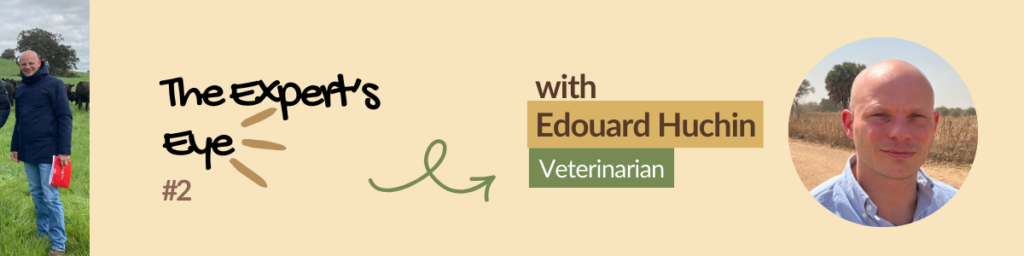
Hello Edouard, could you briefly describe your career path for us?
After graduating from the National Veterinary School of Toulouse in 2008, I began my career by specialising in equine medicine. After gaining initial experience in the field, I completed an internship in equine medicine in Saint-Hyacinthe, Quebec, between 2009 and 2010. Upon returning to France, I practised in a mixed clinic, mainly with equines and cattle, first in Loir-et-Cher for three years, then in Gers for two years.
In 2016, I moved into the poultry sector and took over a practice in Brive within the Anibio group, where I still practise today. The practice has two main areas of expertise, poultry farming and veal calves, although my work is now mainly focused on poultry. Since 2019, I have also been working in slaughterhouses as a contract inspector for the veterinary services in my department (Lot). I am also a trainer in animal welfare and lesion recognition for poultry slaughterhouse staff, and I work as an animal welfare auditor for the poultry, ruminant and pig sectors.
Since 2022, I have also been a reserve veterinarian in the armed forces, a commitment that takes up a few days a year. Finally, for the past two years, I have been actively involved in the development of the One Health concept, an approach that is central to the Anibio group.
What expertise do you bring to Apexagri?
What I bring to Apexagri are skills that are both cross-functional, acquired through my experience in various livestock sectors, and comprehensive, with a vision of the production chain ranging from newborn animals to processed products. This approach allows me to address key issues such as animal health, animal welfare, product traceability, regulatory compliance and sector sustainability.
These skills have led me to participate in international missions in Australia, the United States, Chad and Germany, in a wide variety of contexts and production systems.
In three words, how would you describe Apexagri?
It is difficult to choose just three words, but since I have to, I would say:
- Human: Apexagri is above all a company on a human scale, where relationships, availability and friendliness are central. It is an environment where you feel listened to and supported!
- Dynamic: the company is constantly on the move, very active in developing new missions and strengthening its visibility. The young and committed team brings this energy to the workplace every day.
- Challenging: the projects on offer are intellectually stimulating and represent real professional challenges that are both demanding and particularly rewarding.
What do you like most about working with Apexagri?
What I particularly like about working with Apexagri is above all the variety of assignments. Each project is different, covering a wide range of topics and contexts, which means there is no routine and makes the work particularly stimulating.
I also appreciate the geographical diversity of the assignments: Africa, Australia, the United States, Germany… Being able to discover the world in a professional setting, meet farmers and local populations, and understand very different production systems is an extremely enriching experience.
Even without knowing in advance what the next assignments will be, I know they will be exciting. They offer the opportunity to share our skills, carry out extraordinary projects and take on intellectual challenges that push us out of our comfort zone.
Finally, teamwork is a key element for me. Sharing, complementary skills and the pleasure of collaborating with teams that you get to know well are essential to the success of the missions.
Is there one mission that stands out in your mind?
The mission that made the biggest impression on me was the one in Chad. It involved 10 days in the field, working with a team of 10 people, for a total of 21 days, including a debriefing phase in Paris. It was a particularly ambitious mission, aimed at evaluating the country’s livestock policy and proposing improvement plans, in a context where Chad has the third largest livestock population in Africa.
The mission was very well received, both internally and by the client. The challenge was considerable, but the experience proved extremely rewarding. The exchanges with the transhumant livestock farmers were particularly memorable and meaningful.
It was my first mission in Africa, and it made a deep impression on me and strengthened my desire to continue my commitment to Apexagri!
What do you think are the major challenges for sustainable agriculture?
The greatest challenge remains raising collective awareness of the issues involved in developing sustainable agriculture:
- For farmers: it is essential to anticipate the future. They must be able to rely on sound, viable and economically sustainable tools that are capable of delivering long-term results.
- For distributors: the logic of price wars is now reaching its limits. It is becoming necessary to devise more virtuous models, in which value is better distributed and margins are actually passed on to producers.
- For consumers: they also have a decisive role to play. They are responsible for their purchasing choices: what they favour is produced, what they neglect disappears. It is essential to accept paying a fair price for a product. Wanting quality products, such as organic products, without assuming the cost is not compatible with a sustainable system. Consumers must also accept that more standard products, which meet the majority of needs, are produced locally under controlled conditions rather than being imported from third countries where standards may be less stringent.
- For public authorities: protecting our farmers is a major challenge. The requirements imposed on them are numerous, but they lose all meaning if, at the same time, products that do not meet the same standards are allowed to enter the market freely.
Do you think of a success story in the agricultural world that deserves to be shared?
One project that immediately springs to mind is « Who’s the boss?! ». It’s a virtuous system, both simple and effective, which restores meaning to the relationship between producers and consumers. The products are easily identifiable and accessible on the shelves, allowing everyone to make an informed choice.
Whether you decide to buy or not, the message is clear: by choosing these products, you are directly contributing to a fairer and more responsible model for farmers.
What advice would you give to a company that wants to structure a supply chain or develop an agricultural project?
In order to structure a sector or develop an agricultural project, several principles seem essential to me:
- Surround yourself with experts in the field: professionals who have their « feet on the ground » and understand operational realities and daily constraints. Pragmatism and adaptability are key to success.
- Maintain a permanent link with the field: the planning and development of the project must involve all stakeholders and avoid purely top-down decision-making processes. Collective buy-in is essential to the project’s success.
- Bring together complementary skills: a solid project is based on a multidisciplinary approach, integrating agronomy, veterinary medicine, economics and social issues. This diversity of profiles is essential to understanding the complexity of agricultural sectors.
- Propose a model that is both distinctive AND applicable: successful projects are those that are rooted in the reality on the ground and provide real added value, in line with the expectations of the stakeholders.
- Integrate the sustainability dimension: projects must be in tune with their local environment, not undermine existing activities, and benefit the economic and social fabric.
- Respond to economic reality: an initiative that cannot finance itself or meet a real need cannot be sustainable, however virtuous its intentions may be.
Any final words to conclude this interview?
Thank you to the entire Apexagri team, and I would like to take this opportunity to share greetings from the Anibio team! The partnership between Apexagri and Anibio is a model of virtue and mutual benefit. It allows Apexagri to draw on a network of field veterinarians with diverse profiles, and Anibio to showcase its skills and expertise through rewarding and stimulating assignments.
Many thanks to Edouard Huchin for agreeing to participate in this new format, « The Expert’s Eye », by answering our questions! If you haven’t read it yet, check out our first instalment with Michel Montet.